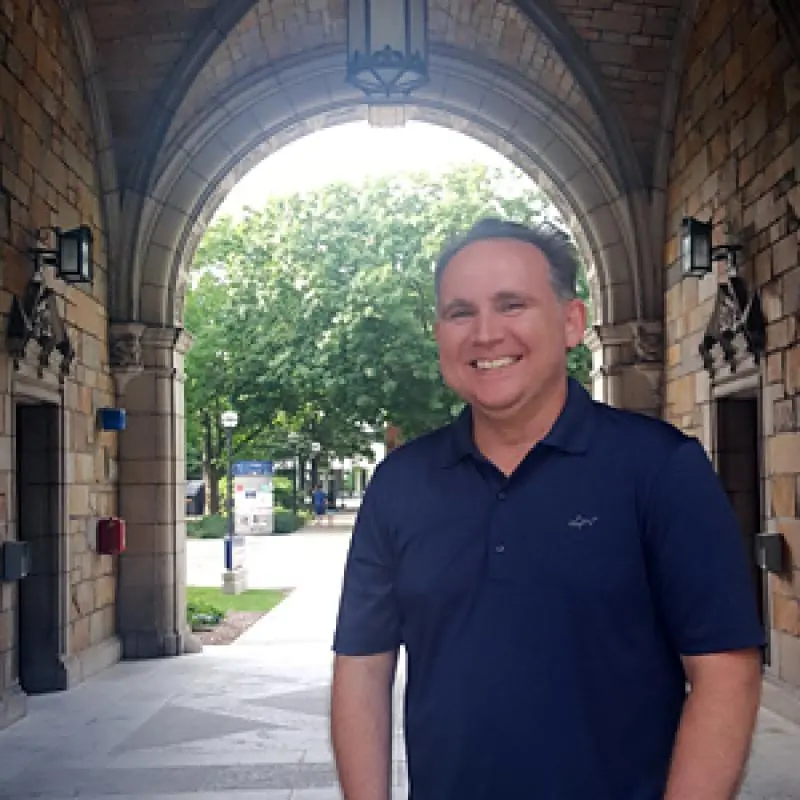

Breaking Barriers award recipient Michael Trevathan teaches students to find their voice
July 8, 2024
CORVALLIS, Ore. - Facilitating active and respectful student discussion around thorny political issues is a challenging practice, and the teachers who navigate it deftly tend to leave a mark.
One such teacher is Dr. Michael Trevathan, a political science instructor and director of the Global Politics Research Lab in OSU’s School of Public Policy, within the College of Liberal Arts.
Trevathan is the 2024 recipient of the Breaking Barriers in Education award, presented by the President’s Commission on the Status of Women. The annual award recognizes a member of the OSU community whose high impact in teaching and mentoring has paved the way to advance gender equity in higher education and allows all to thrive and prosper.
He was nominated by one of his undergraduate students, Narmeen Rashid, who highlighted the way Trevathan cares about his students as fully formed people, not just as students in his class.
“I have never had someone look out for me and help me as much as Professor Trevathan,” she wrote in her nomination. “I am very grateful that he saw something in me, especially because people that look like me are not very well represented in the world of political science.”
Trevathan, who has taught at OSU for six years, says he works hard to make sure his students know that he truly wants to hear their voices and learn what they have to say.
“I make an effort to know every student’s name, to encourage every student to talk, to participate, to share what they feel comfortable sharing,” he said. “I really try to let them know that I’m sincere when I say this — it’s not just a bullet point for me to get through.”
He teaches a wide range of poli-sci courses for all ages of OSU students. His focus is on environmental and global politics, classes that draw a lot of students from outside the School of Public Policy.
He is also the internship coordinator for political science students and a faculty mentor, so helping students find their academic footing is more than just a day job; it’s his calling.
“I try to be someone who looks for the students who often don’t get opportunities that are readily available to others,” Trevathan said. “I also look for students who don’t think of themselves as having that potential, but I see it in them — I’ll read their papers and think, ‘This is a student that has something really great.’”
International relations has traditionally been a male-dominated field, something Trevathan addresses in his courses and research as part of broader discussions around equity and impact. In fact, he’s currently working on a paper on gender representation in the global South as it relates to water insecurity, and how the hours spent fetching and carrying water each day often pull young girls and women away from school and the workplace, limiting their ability to take an active role in politics.
About three-quarters of the undergraduate students currently working in Trevathan’s Global Politics Lab are women and minoritized students.
“I often see where young women might not, in some cases, see a place for themselves in international relations, and I try to really let them know that that place does exist,” he said.
Helping students find success is a very rewarding process, Trevathan said.
“I do a lot of this mentorship because it’s a really amazing opportunity to be with these students and to see them grow and gain courage and strength in their own abilities,” he said. “That’s what really makes this job fantastic: the opportunity to work with great students, and be someone who helped them in one step of their life. That’s important.”
Story By
Molly Rosbach, 541-737-0783
[email protected]